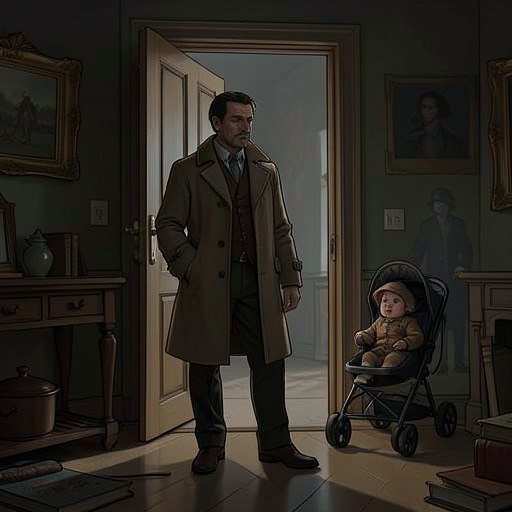
Jared’s attack on Will in the Radley garden
The RadleysJared’s attack on Will in the Radley garden begins as an encounter with an unknown intruder and ends with Will choosing not to kill him. The confrontation exposes a hesitation in Will’s response to violence, while its meaning emerges later when Jared identifies himself and connects Will to Tess Copeland’s death.
The encounter in the garden
Will is sitting outside when a change in the breeze brings back the human scent he had noticed earlier. Remembering a living presence behind the shed, he gets up and walks past the pond. He distinguishes the source from an animal and pauses when he hears a twig crack. After calling out, he hears nothing and weighs whether to investigate the trees or return indoors. He has little desire for the blood he detects, so he turns away.
The retreat does not end the encounter. Footsteps approach at a run, followed by an axe swung at Will. He ducks, catches sight of the weapon, and grabs the attacker by his football shirt. Still holding the axe, the man is carried with Will into the pond. Will pulls him out and tries to identify him, but receives no answer. When Will hears activity in the house and sees Peter and Helen’s light come on, he puts the man back under the water before Peter appears at the window.
Will could kill his attacker, but the setting alters his immediate response: this is the garden of the home shared by his brother and Helen, the woman he loves. Instead of acting at once, he considers that the attack may be a consequence of something he himself did earlier, and that killing the man would create another consequence. Recognition also unsettles him: the attacker’s eyes and blood seem familiar, and Will recognizes fear and hatred in him. Will releases the man without obtaining an answer. The attacker backs away through the water, leaves the garden, and disappears; only afterward does Will curse his own decision to let him go.
Recognition and the disclosed connection
Later, at The Plow, Will finds the man sitting alone with a whisky and approaches him. Their conversation turns to lost loves: Will speaks of his continuing attachment to Helen, who is married to his brother, and asks the man about his own. The man identifies his wife as Tess Copeland, the mother of his child. The name breaks through Will’s earlier uncertainty. He remembers Tess as a student he tutored, their conversation in a university union bar about Michel Foucault and her dissertation, and her uncertainty about being out late when she wanted to return to her husband.
The man then explains that he witnessed Will fly away with Tess. Will’s memory moves from the pub back to the night he killed her on campus, when he also heard someone running nearby and a scream. The garden attack’s familiar eyes and hostility thus acquire a specific history: the assailant is Jared Copeland, Tess’s husband, and his assault follows from having seen Will take Tess away. The delayed recognition links Will’s hesitation in the garden to the consequences he had begun to imagine there, making the later conversation an identification of both the attacker and the past action behind the confrontation.
The delayed answer
The episode is shaped around a question that changes hands. In the garden, Will asks the unknown attacker who he is; later, at The Plow, the man asks who he himself is, before naming Tess Copeland as his wife. The shift turns an attempted identification into a demand that Will confront the identity of the person who took Tess away and killed her. The conversation’s ordinary setting contrasts with the garden’s interrupted violence, while the name Tess Copeland opens Will’s memory of their university meeting and the killing he had left unspoken. By disclosing Jared Copeland’s connection to Tess only after he has escaped the garden, the narrative makes Will’s earlier sense of familiarity legible in retrospect: the hostility he recognized belonged to a witness with a personal claim on the history Will feared his actions had set in motion.
The interrupted prospect of quiet
Before the encounter, Will imagines a quiet life with Helen on a pig farm, with a couple of little sirkers. The returning human scent interrupts that domestic prospect and draws him toward the garden’s hidden presence. The contrast gives the attack a place within Will’s competing futures: the violence he has brought into the Radleys’ garden intrudes upon the peaceful life he can picture with Helen, even as his later hesitation suggests that he is beginning to reckon with what his actions make possible.